

Quickstart
Want to dive right in? Build and run your first Pipecat application
What You Can Build
Voice Assistants
Natural, real-time conversations with AI using speech recognition and
synthesis
Phone Agents
Connect to your agent via phone for support, intake, and customer service
interactions
Multimodal Apps
Applications that combine voice, video, images, and text for rich interactions
Creative Experiences
Storytelling experiences and social companions that engage users
Interactive Games
Voice-controlled games and interactive experiences with real-time AI responses
Multi-Agent Systems
Multiple agents working together on one conversation, driving a live UI as they go
How It Works
Pipecat orchestrates AI services in a pipeline, which is a series of processors that handle real-time audio, text, and video frames with ultra-low latency. Here’s what happens in a typical voice conversation:- Transport receives audio from the user (browser, phone, etc.)
- Speech Recognition converts speech to text in real-time
- LLM generates intelligent responses based on context
- Speech Synthesis converts responses back to natural speech
- Transport streams audio back to the user
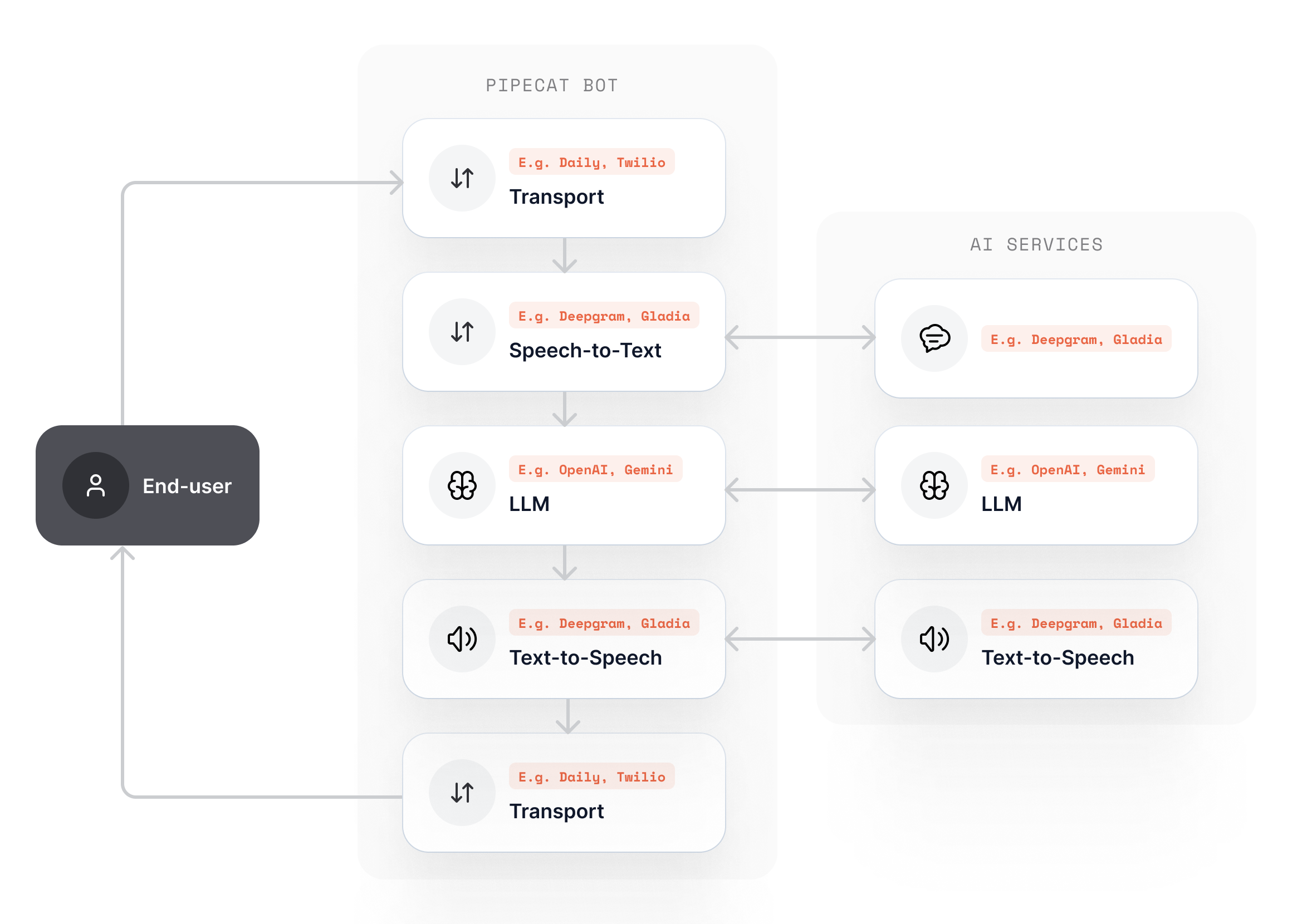
A Multi-Agent System
The bot above is a single agent. Pipecat is also a multi-agent system: the sameWorkerRunner can coordinate many agents that communicate over a shared message bus. Most agents run their own pipeline (PipelineWorker, LLMWorker), while a coordinator can be a plain BaseWorker with no pipeline at all. A normal bot is just the one-agent case, so every Pipecat app is multi-agent ready.
Agent Handoff
Specialized agents that transfer control seamlessly during a conversation.
Job Coordination
Dispatch work to multiple agents in parallel and collect their results.
Distributed Agents
Run agents across separate processes or machines on a shared bus.
Installation
Pipecat requires Python 3.11 or later and is published on PyPI aspipecat-ai. Install the base package with optional extras for each transport, AI service, and utility you need:
Ready to Build?
Quickstart
Build and run your first Pipecat application
Core Concepts
Learn about pipelines, processors, transports, and context management
Supported Services
Browse the complete list of 150+ AI service integrations
Deploy
Deploy to Pipecat Cloud or self-host on your own infrastructure