

- Dockerfile using uv
- Dockerfile using pip
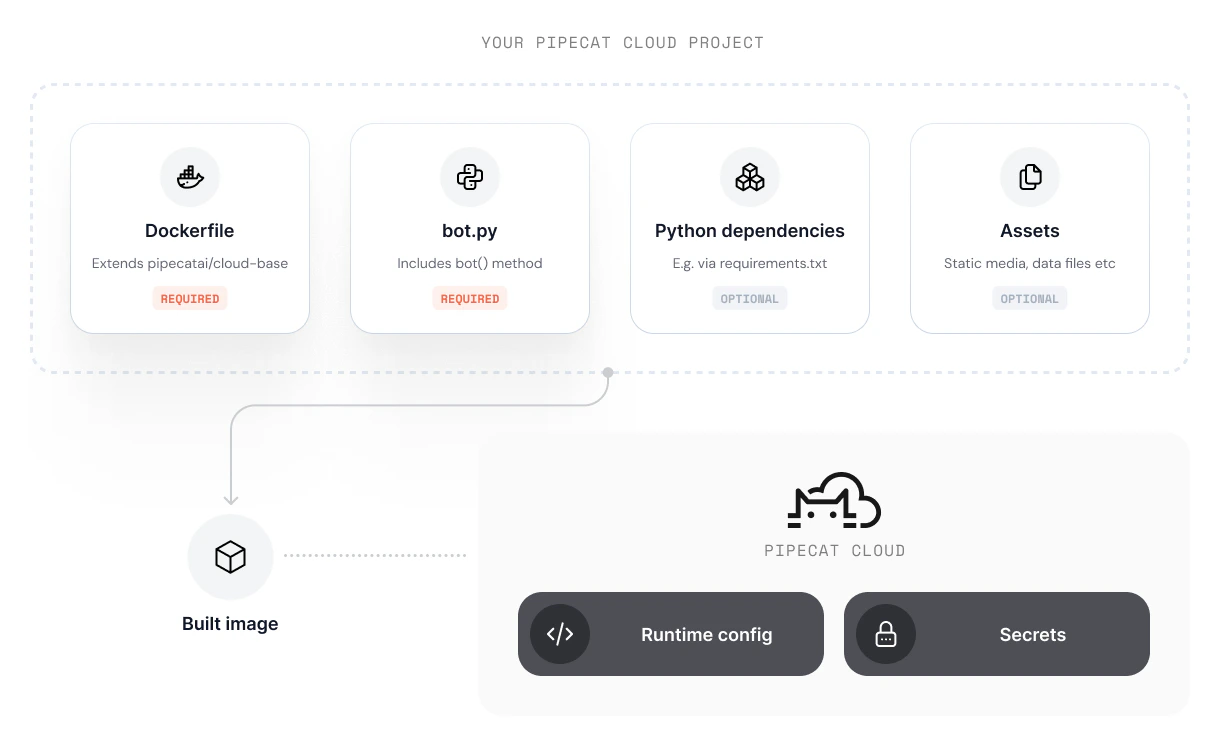
Using an official base image
Pipecat Cloud provides a series of base images that we recommend for most use-cases. Base images provide:- Simplified development and deployment
- Optimizations for performance and security
- Your project must contain a
bot.pyfile that defines the agent pipeline - The
bot.pymust contain abot()method that is the entry point for your agent pipeline - The
bot()method must be asynchronous, e.g.async def bot(): - Your image must install
pipecat-ai0.0.78 or newer
CMD as part of your Dockerfile - the base image is configured to run your bot.py module.
You can browse available base images in the Pipecat Cloud Docker Hub .
pipecat-ai version
The base image does not installpipecat-ai; your image does, at the version you choose. From base image 0.2.0, that version must be 0.0.78 or newer.
When the agent starts, the base image checks two things. Before it imports bot.py, it checks that pipecat-ai is installed. Right after, it checks that it can build the arguments it passes to bot(). If either check fails, the agent refuses to start and prints one line saying why, for example:
pipecat cloud deploy and as the agent’s health message. Agents already running from an earlier deployment keep serving. To fix it, raise pipecat-ai in your requirements and deploy again. If only SmallWebRTC’s arguments fail to build, the agent starts anyway without SmallWebRTC, and logs why.
pipecat-ai older than 0.0.91 still works, but it is deprecated. The agent
logs a warning at startup, and a future base image release will require 0.0.91
or newer.System packages
The base image installs only the system packages its own runtime needs, and keeps no apt package lists. To add a package, runapt-get update in the same RUN as the install:
apt-get update, the install fails with E: Unable to locate package. Install packages in your Dockerfile rather than in pre-app.sh, which runs each time a container starts.
A Python package that loads a system library the image doesn’t have fails to import, with an ImportError that names the missing .so file. Install the Debian package that provides it. For example, pipecat-ai older than 1.6.0 imports OpenCV with SmallWebRTCTransport, which fails with ImportError: libxcb.so.1: cannot open shared object file: upgrade pipecat-ai to 1.6.0 or newer, or install libgl1 as above.
Reserved paths
The base image uses the/app directory for its internal operation. Avoid copying files to /app in your Dockerfile to prevent conflicts with system files.
Reserved HTTP routes
The base image exposes the following HTTP routes for Pipecat Cloud platform integration:These routes are automatically configured based on available features. For
example, the
/whatsapp route is only available when WhatsApp environment
variables are configured.Environment variables
The base image reads the following environment variables. Set them withENV in your Dockerfile, or in a secret set attached to the deployment.
For example, to log at
INFO and withhold conversation content:
PORT, IMAGE_VERSION, PCC_TAG_DEPRECATION, PCC_EXCLUDE_CONTENT, PCC_LOG_DIR, PCC_SESSION_FILES_DIR, PCC_TERMINATION_LOG_PATH, and PIPECAT_EVENT_PUBLISHER_ENDPOINT. Don’t set these.
For WhatsApp integration, the following environment variables are required:
Logging available features
To see which features are available in the base image at startup, setPCC_LOG_FEATURES_SUMMARY=true. This outputs a summary like:
Available base images
The base image supports Python 3.11, 3.12, 3.13, and 3.14. Each tag names its Python version with a
-py3.X suffix.
Python 3.10 images were removed in base image 0.2.0.
dailyco/pipecat-base:0.1.32-py3.10 is the last one, and latest-py3.10
stays on it. To take newer releases, move your image to Python 3.11 or later.dailyco/pipecat-base:latest-py3.11(Python 3.11)dailyco/pipecat-base:latest-py3.12(Python 3.12)dailyco/pipecat-base:latest-py3.13(Python 3.13)dailyco/pipecat-base:latest-py3.14(Python 3.14)
dailyco/pipecat-base:0.4.0-py3.11(Python 3.11)dailyco/pipecat-base:0.4.0-py3.12(Python 3.12)dailyco/pipecat-base:0.4.0-py3.13(Python 3.13)dailyco/pipecat-base:0.4.0-py3.14(Python 3.14)
Using a custom image
For more complex use-cases, you can use a custom image. When doing so, we recommend following best practices to ensure your agent instance runs optimally on the platform. Our base image is open source and serves as a useful blueprint for configuring your custom agent image.Agent image structure
Pipecat Cloud agent images must adhere to a specific structure to run on the platform. Our base images abstract away much of this complexity, but if you are building a custom image, you must ensure your agent adheres to the following:- HTTP API that can handle requests from the platform to configure and run agent instances.
- The necessary system level dependencies (such as Python.)
POST /bot route that will be called by the platform.
We recommend using FastAPI to create this route. Please refer to the base image code for an example of how to do this.
Building the image
If you’re using cloud builds, you only
need a Dockerfile in your project — the CLI builds and deploys your image
automatically. The section below applies if you’re building and pushing images
to your own container registry.
linux/arm64:
- All dependencies required for your agent to run.
- Assets (such as images or models) available in the container filesystem
- The entry point for your agent (usually a Python script)
- Additional system dependencies (if required)
Best practices
- Keep your image as small as possible. Use multi-stage builds to reduce the size of the final image.
- Use a
.dockerignorefile to exclude unnecessary files from the image. - Pipecat Cloud will automatically restart your agent if it crashes. Ensure your agent can handle this gracefully.
- Use Secrets to securely store sensitive information in your agent image.
- To optimize for fast start-ups, avoid long running or blocking processes during initialization.